
You've got three tabs open comparing wrestling software, a stack of last season's paper waivers on the kitchen table, and a board meeting in two days where someone's going to ask why dues collection still runs through a bunch of checks.
The best wrestling club management software is a platform that matches how your club operates, giving volunteer-run youth programs practical tools for registration, payments, websites, communication, scheduling, and background checks, while providing paid academies with the training and business features they need.
Some platforms are built for gyms selling private lessons and monthly memberships. Others are built for a parent volunteer trying to get 80 kids registered, weighed in, and covered by a signed waiver before Saturday's tournament. Knowing which category you fall into changes everything about which tool is worth your time.
This comparison walks through both types, what each one solves well, and where Jersey Watch fits for boards running a season rather than a business.
What makes wrestling club software different from academy training tools?
Wrestling club software falls into two categories:
- Administration-first platforms built for volunteer-run seasonal clubs.
- Academy tools built for paid coaches selling year-round training
Clubs pick better tools when they match software to how they operate rather than to every feature a wrestling program could theoretically use.
Before comparing platforms, ask one question: Does a volunteer board run a season or does your organization sell instruction?
Administration-first platforms built for volunteer-run clubs
Volunteer-run wrestling clubs need software that helps run a season rather than manage a gym business. That means one dependable home for registration, a website, dues, waivers, coach background checks, team messages, and schedules.
Compare platforms by how many of these recurring jobs stay within a single workflow. A parent volunteer checking payment status between errands, then sending a snow-cancellation notice before evening practice, all from one place, is what this category is built for.
Academy and gym platforms built for paid coaches
Academy tools are built for coaches running wrestling as a year-round business, selling classes, memberships, and private lessons. Look for features like weight tracking, attendance, video review, recurring membership billing, staff scheduling, and payroll. A wrestling academy that bills members monthly while a coach reviews an athlete's takedown video between private sessions is a business, not a season.
What should seasonal youth wrestling clubs look for in administration-first software?
The best youth wrestling club software streamlines weekly tasks and saves volunteer time. Rank features by frequency: registration and payments first, your public website second, then communication and safety workflows.
Start by reviewing last season's biggest headaches, whether that's missing waivers, untracked cash, or repeated weigh-in questions, before booking any demos. That list becomes your checklist. Score every platform against those pain points, rather than flashy extras you'll rarely use.
Online registration and digital waivers
Online registration should be the one place families go instead of paper packets, spreadsheet rosters, or waivers chased down at the gym door.
Build a single form that collects age group and division or grade, weight class, emergency contacts, singlet or shirt size, medical notes, signed waivers and parent permissions, and club policies and membership number.
Test the form with a few board members first. Confirm submissions can be sorted or exported so a registrar can filter wrestlers by division and singlet size before handing out equipment.
Payment processing for dues, camp fees, and tournament costs
Payment tools should make it simple for families to pay dues, camp fees, and tournament costs in a few clicks. Online payments let treasurers instantly see who's paid, cut down on cash handling, and keep season budgets easier to track.
Test whether each fee links directly to the right registration or event, and whether records export cleanly. A treasurer checking outstanding tournament fees on a laptop instead of comparing cash envelopes against a spreadsheet is a good sign the tool is working.
A professional website for recruiting new families
A club website lets new families find registration dates, schedules, dues, and a point of contact without emailing a volunteer first. It also gives sponsors visibility, helps prospective coaches find your application, and keeps offseason updates in one place.
Do a quick audit of your main navigation. Can visitors easily spot age eligibility, practice location, dues, and tournament expectations? A first-time wrestling parent scanning your site for fees and practice times will make up their mind in about 30 seconds.

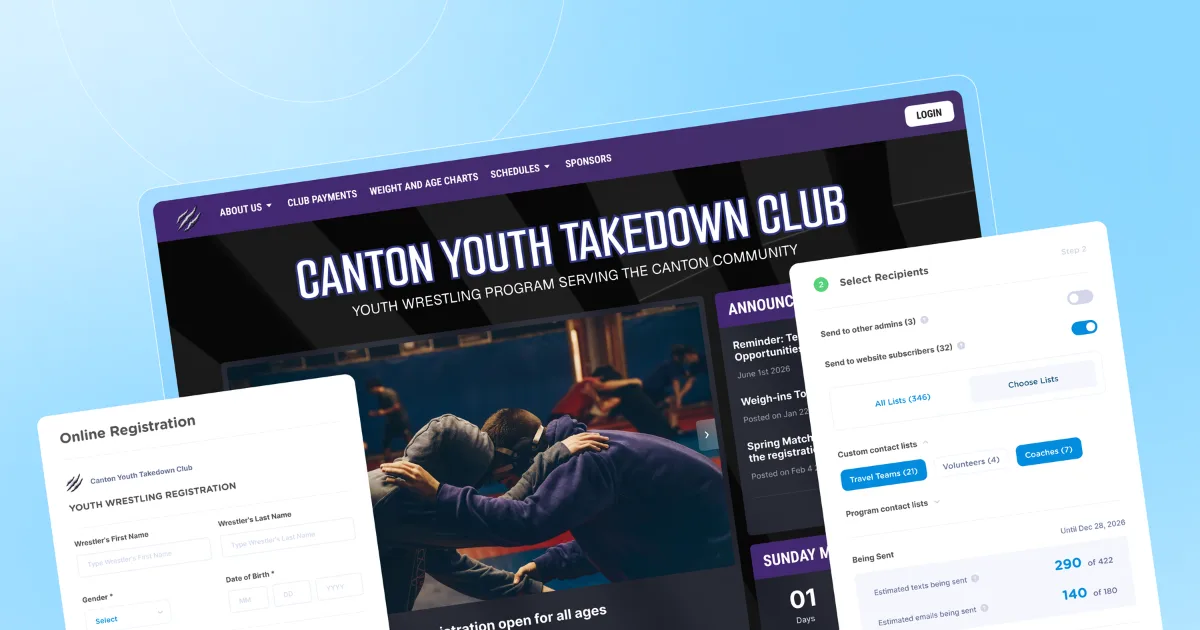
A youth wrestling website created using Jersey Watch's website builder
Parent and athlete communication tools
Good communication tools keep wrestling families clear on weigh-ins, mat times, cancellations, and location changes without a single confused text chain. Research on supportive parent involvement in competitive youth sport shows calmer, informed parents help athletes perform better. Consistent club updates create that calm.
Check whether your software sends SMS and emails to your entire club or only to selected groups, so you can text a weigh-in reminder to one age division while emailing a snow cancellation to everyone.
Background checks for volunteer coaches
Background checks help your club keep youth wrestlers safe and give parents confidence in who's coaching. A smooth workflow looks like this: the coach gets an invitation, completes the screening online, and your board reviews the status right in your admin account.
Ask any platform whether checks can be started and tracked without a separate spreadsheet. A parent coach joining two weeks before the first tournament should be able to complete screening from their phone, and your board should confirm clearance before they step on the mat.
Top wrestling club management software options to consider
The right software depends on your operating model, not on which platform has the longest feature list. A seasonal youth club, a performance-focused program, a paid academy, and a larger multi-sport organization all need different tools. Find your row first, then compare features.
The platforms below are compared on the recurring jobs that volunteer boards and academy staff handle each season. Each platform is scored by how many of those jobs it covers in one system rather than by total feature count.
Platform | Best fit | Core strengths | Pricing | Website builder | Background checks | Organization size |
Jersey Watch | Volunteer-run seasonal clubs | Unified website, wrestler registration, and payments | $19 for month one, then $348 per year billed annually, plus 3.5% + $1 per transaction | Included | Included | Youth sports orgs with 50-1,000 athletes |
WrestlingIQ | Competitive youth, high school and college clubs. | Coaching tools (attendance, practice plans, private lessons) | Based on organization type. Club pricing is payment transaction only | Add-on (Basic $99 per year or Premium $49 per month + $500 setup) | Not a primary focus | Competitive programs |
Upper Hand | For-profit academies | Camp, clinic and class registration plus memberships and staff management. | Starts at $79 per month, when paid annually. Website is an additional add-on. | Add-on ($50 per month) | Not a primary focus | Paid academies and gyms |
TeamSnap ONE | Larger or multi-sport orgs | Communication, coaching resources and registration. | Custom pricing, contact for quote. | Included | Unknown, not listed on site. Contact for more information. | Multi-sport organizations |
Jersey Watch for volunteer-run, seasonal youth wrestling clubs
Best for: Clubs where volunteers run the season.
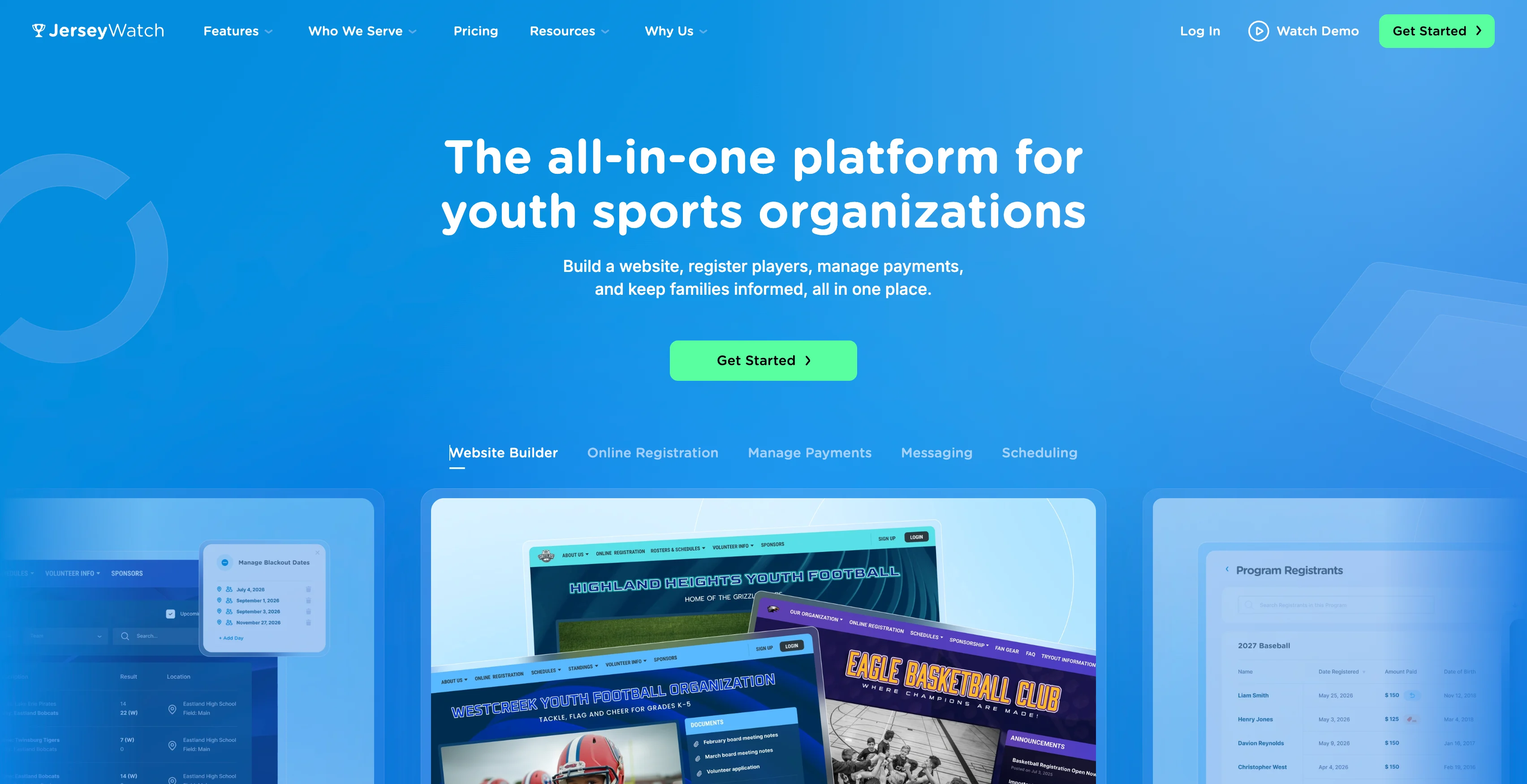
Jersey Watch is built for administration rather than athlete-development analytics, so it works best when your board needs help with the everyday logistics of a wrestling season: registration and payments, a public website, SMS and email messages, scheduling, and background checks.
A small board can use online registration to collect dues and signed waivers, post tournament dates on the club website, then text families a changed Saturday arrival window, all from one place. Each piece connects, so volunteers spend less time chasing paperwork and more time getting wrestlers to the mat.
Standout features: Registration, payments, website builder, plus other season tools. Five-star customer support that responds in an average of 45 minutes. Free content migration and design assistance included.
Volunteer ease: High. Built for non-technical users, with responsive support throughout the season.
Pricing: $19 for month one, then $348 per year billed annually, plus 3.5% + $1 per transaction.
WrestlingIQ for coached, competitive programs focused on athlete development
Best for: Programs with dedicated coaches who build training plans around individual athlete growth.
WrestlingIQ leans into wrestling-specific tools like stats tracking, video review, and practice planning, which makes it a stronger match for performance-focused coaching staff than for volunteer boards trying to get a season up and running quickly. Before ranking it high on your checklist, ask one question: will coaches use these tools every week?
A competitive coach reviewing a wrestler's match footage between tournaments, comparing takedown attempts from one weekend to the next, is the use case this platform is built for. If your club's real needs are registration, dues, and communication, keep those priorities front and center.
Standout features: Match video review, stat tracking, practice planning, attendance, messaging, and online registration with payment processing.
Volunteer ease: Moderate. Feature-rich for coaching use; built more for coaches than for volunteer administrators.
Pricing: No monthly subscription fee for clubs. WrestlingIQ adds a 2% fee to the parent bill, plus standard card processing fees of 2.9% + $0.30 per transaction. A website is a separate add-on: Basic at $99 per year (self-serve editor) or Premium at $49 per month plus a $500 setup fee (custom design with concierge updates).
Upper Hand for for-profit wrestling academies running memberships and staff payroll

Best for: For-profit wrestling academies that run classes year-round, employ coaching staff, and need to manage sessions like a real coaching business.
Upper Hand handles recurring memberships, staff scheduling, facility management, payroll, and retail inventory. If you're processing recurring memberships, scheduling paid instructors, and handling payroll, this is a different job than collecting seasonal dues and waivers from a volunteer board.
A seasonal youth club typically deals with one-time dues, tournament fees, and signed waivers each season. An academy deals with ongoing billing cycles and staff pay. Neither model is better, just different. Ask yourself whether recurring billing and payroll are must-haves before ranking this option first.
Standout features: Recurring membership billing, staff and payroll management, facility and resource scheduling, retail and inventory, registration and payments.
Volunteer ease: Lower for a seasonal volunteer board; built for business operations with paid staff.
Pricing: For independent coaches and trainers, plans start at $79 per month when billed annually. Their website builder is a separate add-on at $50 per month.
TeamSnap ONE for larger or multi-sport organizations

Best for: Community organizations running wrestling alongside other sports that need one registration and payment system across departments.
TeamSnap ONE bundles registration, payments, a website, scheduling, communication, and coaching resources into a single system. That scale-oriented setup makes sense when a program manages wrestling alongside soccer, baseball, and basketball under one administrative roof.
For a small, single-sport volunteer wrestling club, that same setup may bring more complexity and cost than the season requires. Before requesting a quote, confirm that pricing is based on the total participant count across all sports, clarify which departments will share the system, and ask how support works when multiple sports use one account.
Standout features: Communication tools both for organization-wide updates and parent communication, coaching resources and registration with integrated payments.
Volunteer ease: Moderate. Well-supported but designed for larger, multi-sport administration.
Pricing: Quote-based. Contact TeamSnap ONE directly for pricing specific to your organization's size.
How Jersey Watch fits the volunteer-run wrestling club model
What sets Jersey Watch apart from other options on this list isn't a longer feature list. Instead, it's the support and ease of use built for people who aren't doing this as their day job.
Boards, coaches, and commissioners handling season admin after work don't have time to learn a complicated system or wait days for a support ticket response. Jersey Watch's registration, payments, website, messaging, and background checks all live in one place specifically because that's what a volunteer with an hour a night can actually manage, and real support is there the moment something breaks.
The payoff shows up in everyday outcomes: Families register faster online, treasurers see who's paid without chasing envelopes, coaches complete background checks before practice starts, and parents get timely updates instead of guessing.
A website that helps you recruit new wrestlers
Jersey Watch gives your club a professional website where new families can find registration dates, practice schedules, and season costs in one place. That matters most when a busy parent is scrolling on their phone, deciding whether to sign a kid up for wrestling.
Setup includes a custom domain, design help, and content migration at no extra cost, so nobody has to build a site from scratch. Before you start, list the pages and files you need to move over.
Registration and waivers without the paperwork chase
Jersey Watch lets your club collect registrations and waivers online, so nobody has to hunt down a form clipboard-side at practice. Build one form that pulls together the essentials: age group, weight class, medical notes, parent contact info, singlet size, and acknowledged club policies, in a single spot.
Start by recreating your existing paper questions in the online form. Test every required field yourself before you open registration to families. The goal is a registrar who can sort completed submissions by division and weight class weeks before team assignments, without copying data between spreadsheets.
SMS and email for weigh-ins and schedule changes
Jersey Watch lets clubs send SMS and email updates when wrestling logistics shift. Weigh-ins move, gyms close for snow, mats get reassigned, and buses run late.
Before the season starts, sort your contacts into groups by age division or team. When Saturday's weigh-in time shifts an hour, you can text just that division while emailing everyone the full tournament schedule.
Background checks built right into signup
Jersey Watch lets boards send coach background checks as part of volunteer signup, so screening records live alongside the rest of your onboarding info instead of scattered across emails and sticky notes. That means a clear, reviewable status for every coach before they set foot on the mat.
Before opening coach signup, decide who needs a check (head coaches, assistants, mat helpers) and whether clearance must be complete before or during preseason practice.
Is free wrestling club software ever enough for a growing club?
Free tools can get a small club through its first signup season. Once your roster grows, those scattered forms and group texts start creating more work instead of less.
Picture a 50-participant club using a free form and a spreadsheet for early signups. It works fine until multiple weight divisions, tournament fees, and a late-joining volunteer coach show up, and suddenly someone's manually copying data between four different places.
Here's a quick test: List every tool your club used last season, then count how many times you copied the same information from one place to another. That number tells you how much unpaid time your volunteers are spending on data entry.
Paid club software starts earning its keep once payments, website updates, dues, waivers, coach checks, and messages become recurring season jobs rather than occasional tasks.
Your wrestling club deserves software built for how you actually run it
If you're a volunteer board running practices, meets, and a fundraiser between everyone's day jobs, the real win is picking a system that keeps registration, dues, waivers, and coach background checks in one place you can keep up with. That's the honest standard to hold any platform to, wrestling-specific or not.
Jersey Watch pairs a simple club website with powerful registration, payments, and family text and email updates, so a parent volunteer can manage it without needing a tech background or a training manual. Before your next tournament sneaks up on you, it's worth setting your club up so the paperwork chase doesn't happen again.
Set up your club's free account today and have registration, waivers, and weigh-in updates ready well before the mats get rolled out.
FAQs
Can wrestling club management software replace USA Wrestling membership?
No, club management software does not replace USA Wrestling membership or sanctioning. It supports local signups, payments, websites, schedules, and family messages, while families may still need to complete national membership requirements through the appropriate governing body. A club can use its registration form to collect membership numbers, emergency contacts, waiver acknowledgments, and other required details in one place.
Do youth wrestling clubs need separate tournament bracket software?
Separate bracket software is useful when a club hosts events that require seeding, weight classes, mat assignments, and match results. Club management software handles the surrounding administrative work, including registration, payments, website updates, schedules, and parent communication. Many youth clubs use both so event staff can manage brackets while volunteers keep families informed and organized.
How can a wrestling club move from paper forms to online registration?
Start by turning the current paper form into an online form that includes fees, waivers, and required family and wrestler information. Have a small group try it out first, fix anything confusing, and then share the registration link through the club website, email, and text. Catching issues early helps avoid problems once dozens of families start submitting their information.
Can wrestling software manage age groups, skill levels, and weight classes?
Yes. Suitable wrestling software can help clubs organize athletes by age group, grade, experience level, and weight class. For volunteer-run programs, custom registration questions can keep those details together and reduce the need for separate spreadsheets. Competitive academies may also need deeper attendance, progress-tracking, video, and coach-note features.
What should a wrestling club board ask before choosing software?
A wrestling club board should ask about registration, payment fees, website setup, annual pricing, background checks, messaging, scheduling, customer support, and data exports. The board should also confirm whether the platform is designed for seasonal volunteers or for a year-round academy with paid coaching staff. The best choice is the system that handles the club's recurring work without adding tools or complexity volunteers won't use.

Tim GusweilerCo-Founder / CEO
Tim is the Co-Founder of Jersey Watch, where he works with the product, marketing, and customer support teams to build software for youth sports organizations. He writes about youth sports management based on years of experience working with league administrators, coaches, and volunteers, along with a lifelong passion for sports.


