
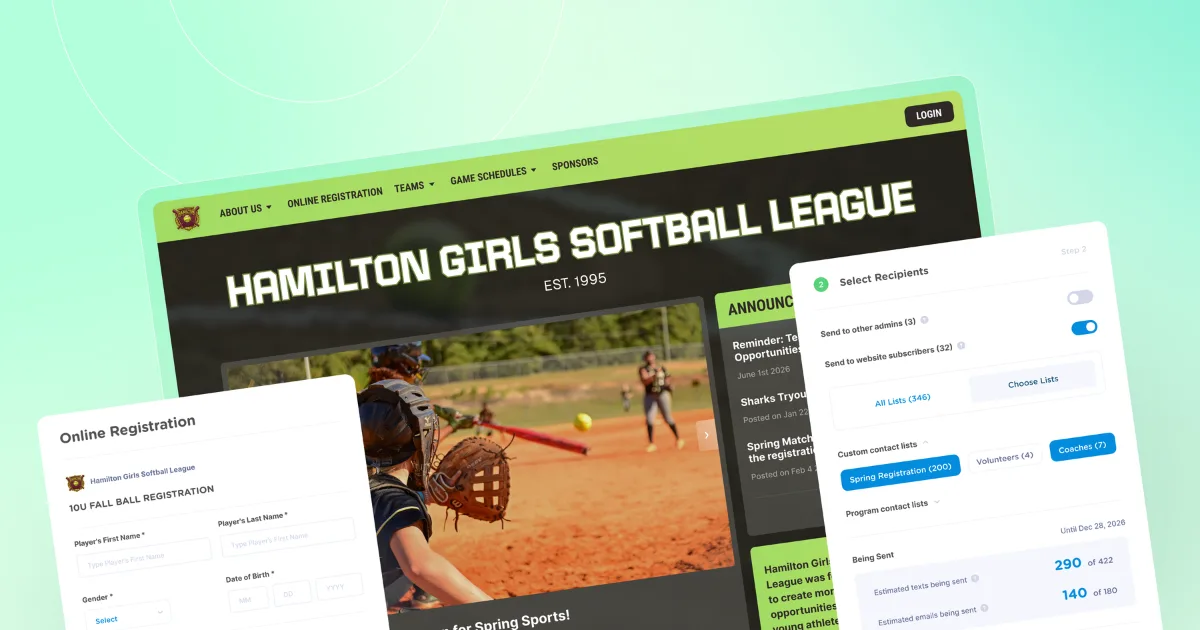
It's Tuesday night, registration closed an hour ago, and you're not sure who paid, who confirmed the field for Saturday, or who's tracking either one. This is the moment most volunteer softball boards realize they need better systems.
The best softball league management software combines registration, online payments, a league website, scheduling, and family communication into a single, simple system. It should help non-technical volunteers manage a full softball season while keeping records organized for future board members.
If you're comparing options, you're probably weighing ease of use against price and wondering which platform fits a softball season's rhythm of tryouts, rainouts, and playoff brackets.

What is softball league management software, and why does it matter for volunteer-run leagues?
Softball league management software matters because it gives families and volunteers a single, reliable website hub for sign-ups, payments, schedules, and season updates. Instead of registration living in one app, payments in another, and schedules pinned to a bulletin board, everything connects through your softball league's website. Parents visit one place. Volunteers manage one system.
This kind of setup fits a single-field rec league with 50 players just as well as a multi-division organization running 1,000 athletes across several fields. Size doesn't change the need for a shared home base.
The shift looks like this: a treasurer no longer collects paper checks, sign-ups no longer scatter across Facebook comments, and payment confirmations no longer bury themselves in Venmo notifications. Registration, payment status, schedules, and family contacts all live in the same system, visible to every volunteer who needs them.
Signs your softball league has outgrown paper, spreadsheets, and group texts
Routine sign-ups, payments, field changes, and family updates that still require manual follow-up from the same few volunteers are the clearest sign that your softball league has outgrown paper, spreadsheets, and group texts. When several of these problems hit the same week, the same one or two volunteers end up absorbing it all.
Four warning signs signal this tipping point: payment headaches, communication breakdowns, volunteer turnover risk, and free tools stretched beyond their limits.
The true cost of cash payments and manual bookkeeping
Cash and check collection costs your softball league more than the time it takes to walk a deposit to the bank. Every check brings error risk, refund headaches, and more difficult board reports.
Before comparing platforms, total up what your league truly spends: subscription fees, payment processing fees, refund handling time, hours spent matching payments to players, and hours spent building board reports. That full picture, including costs beyond the sticker price, tells you what manual bookkeeping is really costing your season.
When group texts and email chains stop working
Group texts and email chains stop working when one softball update needs to reach several teams, divisions, or fields at once instead of just your own roster. A single team thread is easy to manage, but softball leagues rarely stay that simple past opening week.
Picture a coach texting their team that Field 3 is flooded and games have moved to Field 5. That message never reaches the three other divisions also scheduled at Field 3 that day, so their families show up to an empty field.
Think back to your last league-wide update. If reaching every affected family meant texting five different people instead of pulling from one contact list, that's the gap a shared system closes.
The volunteer turnover problem: What happens when the one person who "knows everything" moves on
Software protects your softball league from having to start over when an experienced volunteer leaves by keeping shared records, multi-admin access, and season history in one place. When one registrar or treasurer keeps everything in their head, or worse, in a personal login, the league inherits issues the moment that person moves on.
A shared system fixes this by design. A new registrar can log into the same platform an outgoing volunteer used, without needing their personal password. Prior-season schedules, registration records, and payment history stay attached to the league account rather than to a single person's inbox or spreadsheet.
Take a few minutes this week and list every task or account tied to a single volunteer's memory or login: the registration platform, the bank account, the group text list, the scheduling spreadsheet. That list is your handoff plan for next season.
What free tools can still handle, and when they stop being enough
Free tools reliably handle simple, single-purpose jobs: a Google Form for a coach availability survey, a shared spreadsheet for snack duty, a group calendar for early offseason planning. That reliability breaks down once payments, waivers, and multi-team communication enter the season. Online payments, waivers, multiple divisions and fields, and several board members needing access to the same records all push a Google Form past what it was built for.
Count it yourself: how many separate tools does your league use, and how many times does someone type in one player's information by hand? If the answer is more than one or two, it's time to look at a shared system.
5 things to look for when comparing softball league software
Volunteers should compare softball league software on five criteria: website, registration and waivers, scheduling, communication, and fundraising, with ease of use for non-technical volunteers guiding every decision. They’re the ones opening registration, collecting fees, publishing schedules, texting families about rainouts, and running a fundraiser, often without any tech help.
A good all-in-one platform should make all five feel connected, rather than requiring five separate logins.
A professional website (without needing a developer)
A softball league website should serve as a single mobile-friendly hub where families can find registration, schedules, news, and contact info without hunting through social posts and old flyers. Test any platform for custom branding, whether the schedule updates automatically rather than living on a separate page, and how the site looks on a phone.
A self-serve builder with an integrated schedule means a volunteer can post an urgent field change tonight without calling a developer, turning what could be a stalled ticket into a two-minute update.
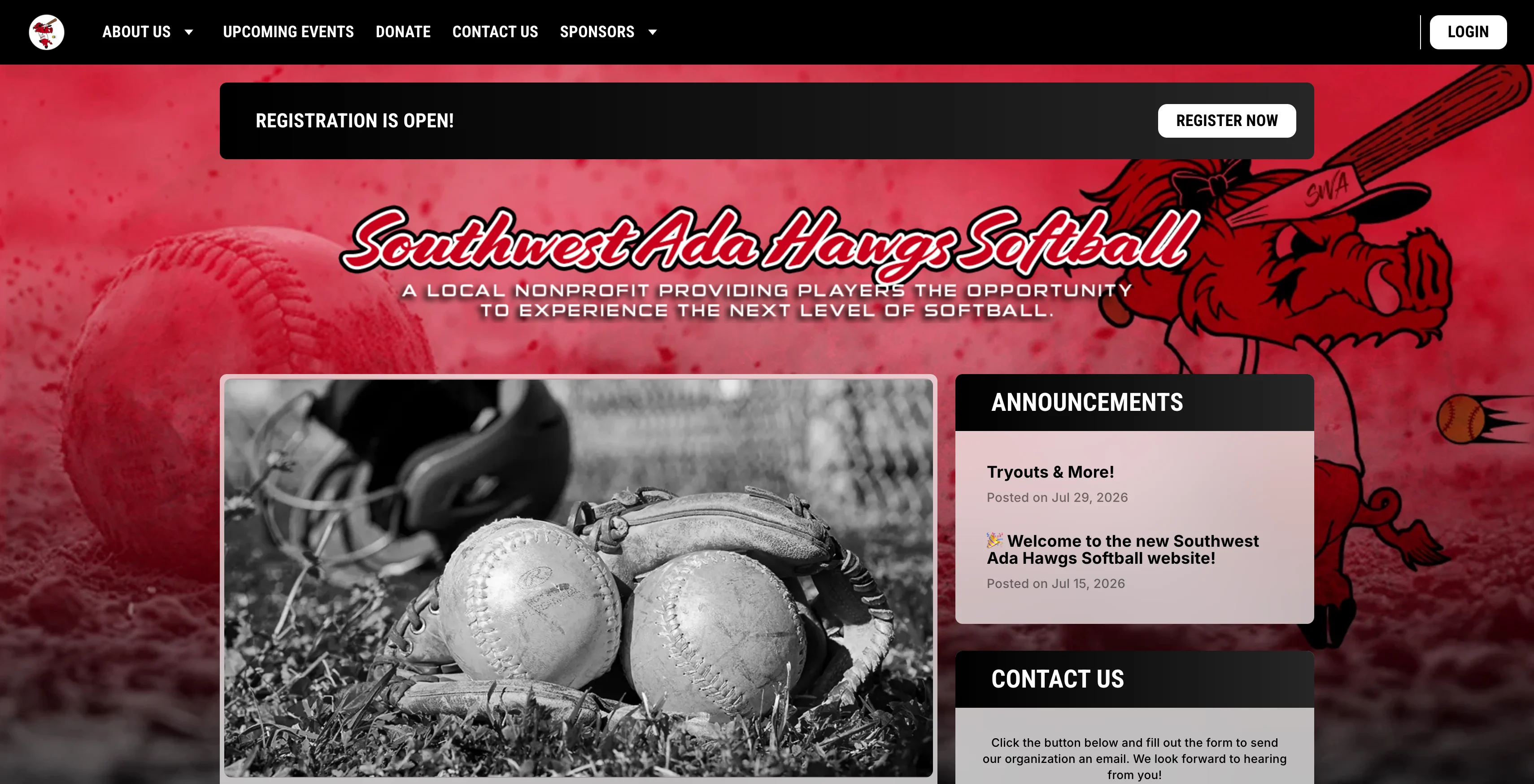
For a deeper look at specific templates, check out this softball website template roundup. For step-by-step build instructions, see this guide to building a youth sports website.
Registration and waiver collection families can finish in minutes
A strong softball registration system lets families submit player details, emergency contacts, waivers, program choices, and payment in a single, streamlined online flow.
The form itself matters as much as the platform. Clear field labels, logical section order, and a waiver step that can't be skipped all reduce the follow-up calls your registrar fields before opening day. Requiring only what you actually need, rather than building the longest form possible, also helps families finish on a phone between innings instead of abandoning halfway through.
On the admin side, look for clean record exports, clear payment status at a glance, and refund handling that doesn't require a spreadsheet workaround. For a deeper look at what separates a good registration system from a great one, check out Jersey Watch's sports registration software comparison.
Scheduling across teams, divisions, and multiple fields
Strong softball scheduling software coordinates divisions, teams, practices, games, and fields while catching conflicts and publishing rainout changes fast. A basic calendar can list events, but it can't tell you that 10U and 12U just got booked on the same field at the same time.
Conflict detection and multi-field coordination prevent that double-booking headache. Look for a schedule generator that lets you set field availability, assign age-division rules, and automatically flag overlaps before you hit publish.
While testing platforms, check out the capabilities by bumping one division's game to a different field and check how quickly the public schedule reflects it. If families can see the new times within minutes rather than hours, the tool is doing its job.
Communication tools that reach every family, every time
Reliable softball communication tools send email and text updates to the teams, divisions, or families a change affects. That precision means nobody misses a rain delay because a message got buried in the wrong group text.
Pulling contact groups from your current registration records makes this possible. Instead of copying phone numbers into a new thread every season, you can select specific groups or lists and the right families show up automatically.
Use this for uniform pickup reminders, playoff brackets, field closures, and last-minute practice changes.
Fundraising tools built into your league's platform
Built-in fundraising tools reduce duplicate work by tying campaign sales and payments to the family, registration, and payment records your softball league already keeps, rather than running on a separate system. Before, a team fundraiser meant a separate spreadsheet or a third-party app, with someone exporting sales data and matching names to your roster by hand.
With league software, volunteers can view donations made during registration, through website modules or via sponsorship payments. It’s easy to see who made a payment, for how much and where those funds should route to.
Check the types of fundraising tools each platform offers. Features vary but can include one-time or recurring donations, sponsorship forms, sponsorship ad placement and fundraising goal meters.
Softball league management platforms worth comparing
Jersey Watch, LeagueApps, and SportNinja are worth comparing because each serves a different combination of volunteer simplicity, advanced administration, and game-day operations. The right pick depends on how your league runs its seasons and hands off its board.
We compared all three on registration and payments, website, waivers, scheduling across fields and divisions, communication, and volunteer ease. Each entry explains who it fits best.
Jersey Watch
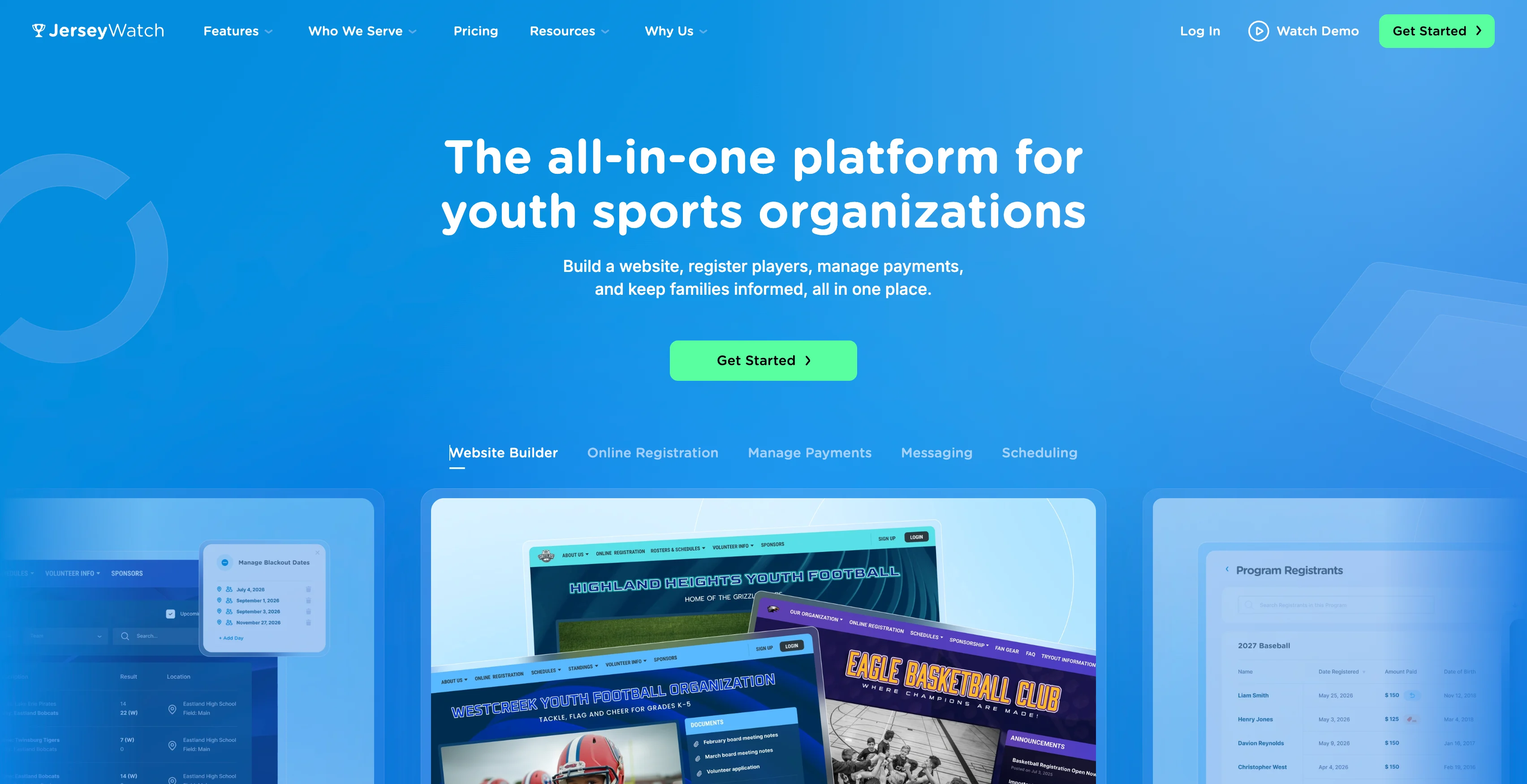
Best for: Volunteer-run softball leagues that want registration, payments, a website, scheduling, and messaging in one place without technical setup.
If your board is made up of parents squeezing league work between jobs and games, that combination matters more than a single feature. A recreational season brings a predictable list of headaches: collecting waivers before opening day, sorting players into divisions, posting field assignments, and getting a rainout notice out fast.
Jersey Watch handles those tasks through one login. It collects registration and waivers online, posts payments automatically, publishes division schedules on the website, and sends email or text updates to the families affected by a field change.
Setup starts with a custom domain name for your league's website, built through a self-serve website builder anyone can use regardless of coding knowledge or design background. If you're switching from another system, free content migration moves your existing records instead of making you retype rosters from scratch, and design assistance is available if you want help getting the site looking right. Responsive customer support is available during setup and throughout the season.
Standout features: All-in-one registration, website, payments, scheduling, and communication, plus five-star customer support. Free content migration and a custom domain are included.
Volunteer ease: High. Self-serve setup, hands-on support, no technical background required.
Pricing: $19 for month one, then $348 per year billed annually, plus 3.5% + $1 per transaction.
LeagueApps

Best for: Larger or more operationally complex softball organizations handling high-volume registration and advanced league or facility operations.
LeagueApps is built for large multi-site travel clubs running several age divisions across different fields, or tournament organizers registering hundreds of teams in a short window. LeagueApps handles that kind of complexity, with registration and payment tools, website options, waiver collection, scheduling, facility management, roster management, and communication features built for bigger, busier workflows.
Standout features: High-volume registration, flexible payment rules, facility management, multi-division scheduling.
Volunteer ease: Moderate to heavy. More setup time required; better suited to organizations with dedicated administrative staff.
Pricing: Transaction-based. LeagueApps charges a percentage of each online payment rather than a flat subscription fee, plus a one-time setup fee. No publicly listed rates; requires a demo and quote.
SportNinja

Best for: Softball leagues that prioritize live scoring, real-time statistics, and game-day operations alongside scheduling and registration.
SportNinja is built around real-time score updates, stat tracking, and schedule management, which line up well with tournament play and competitive divisions where teams and fans want to follow results as they happen. Registration and payments are included on paid plans, and a free tier is available for organizations with up to 50 participants.
Standout features: Real-time mobile scoring, full stats and standings, live video streaming, integrated registration and payments.
Volunteer ease: Moderate. Strong for game-day operations; website integration uses a web plugin that embeds into a site you already have rather than building one from scratch (an Ultimate plan with a custom website is available for larger organizations).
Pricing: Free for up to 50 participants. Pro is $50 per month and Ultimate is $100 per month (both for up to 500 participants, tiered upward beyond that). Standard transaction fees apply to registration payments processed through Stripe or SportsPay.
Give your softball league tools to focus on the game instead of the paperwork
The right softball league management software lets your board focus on the game instead of the paperwork, especially during a mid-season handoff to a new volunteer.
Pull up your current registration form, your last team text blast, and your website's last update date this week. If any of those feel like a chore, that's your sign to start comparing real total cost and softball-specific workflows instead of just feature lists.
Jersey Watch was built around that handoff problem: registration, payments, schedules, and family communication living in one place so a volunteer board can rotate without losing momentum. You can try running your next season through it and see how the pieces fit together.
Ready to see what that looks like for your league? Set up your next softball season in minutes with Jersey Watch.
FAQs
What features should the best softball league management software include?
The best softball league management software should combine registration, payments, a website, scheduling, and family messaging into a single volunteer-friendly login. This setup helps families sign up faster and gives board members cleaner records each season. Shared multi-admin access and season history also make it easier for new volunteers to step in without having to chase down separate spreadsheets or personal logins.
What is the best free softball league management software for small leagues?
Google Forms, spreadsheets, and shared calendars can still work as free softball league management tools for very small leagues with basic sign-ups. As discussed above, those tools tend to break down once payments, waivers, and multi-team communication come into play. At that point, compare the cost of paid software against the volunteer time, bookkeeping errors, and parent confusion caused by disconnected tools.
How much does softball league management software typically cost?
Softball league management software costs may include a platform fee, payment processing fees, or both. Compare the total cost rather than the advertised subscription alone, including what the league pays, what families pay, how refunds work, and which setup or support services are included. The right option should protect registration revenue while saving enough administrative time to justify its cost.
What's the difference between softball scheduling software and full league management software?
Softball scheduling software manages games, practices, fields, and sometimes officials, scores, or standings, without the registration, payment, and communication features of full league management platforms. Full league management software adds registration, online payments, website updates, family messaging, waivers, and shared access for board members and coaches. A full platform is usually more useful when separate tools are creating duplicate work or inconsistent information.
How do I move my softball league from paper registration to an online system?
To move from paper registration to an online system, rebuild your paper form online, covering the same player and family details you currently collect, plus fees and any volunteer questions your league needs. Publish one registration link on the league website, confirm it works end-to-end, and send email or text reminders before the deadline. Keep the resulting payment and player records in a shared administrative account so future volunteers can manage the next season without starting over.

Courtney CalvoCustomer Care Team Lead
Courtney Calvo is the Customer Care Team Lead at Jersey Watch, where she helps youth sports organizations get started with registration, websites, and league management tools. She brings both professional expertise supporting leagues and firsthand experience as the parent of a youth soccer player.


