
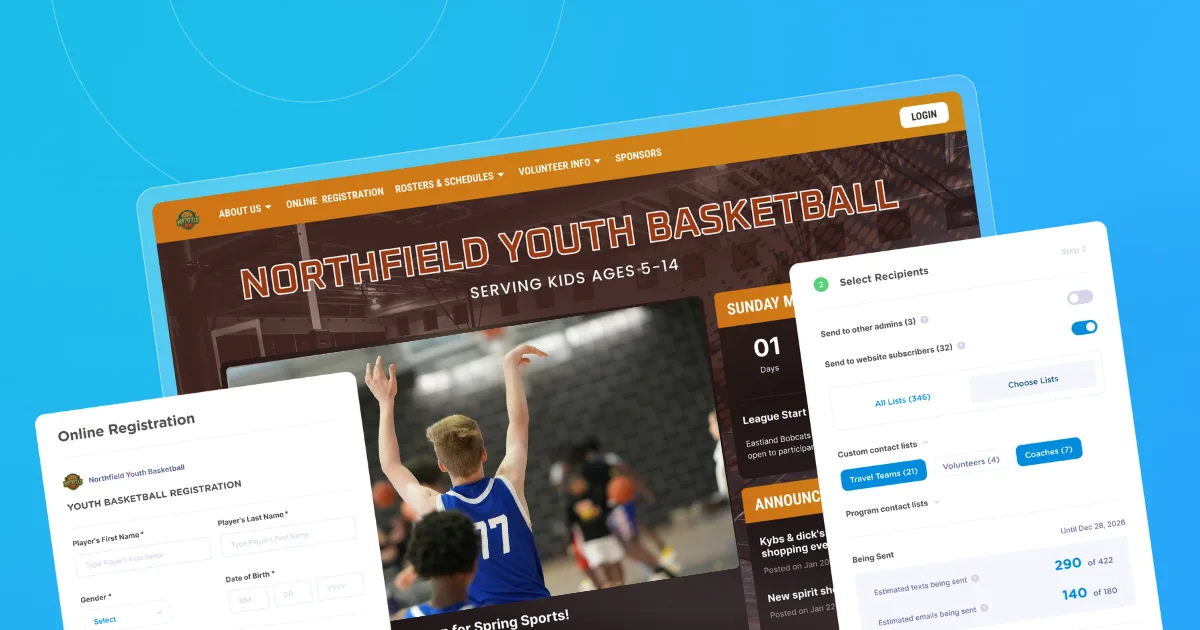
Your league's group text is blowing up again, this time because the middle school gym got double-booked for Saturday's games. You're also chasing three families for registration fees, updating a spreadsheet nobody else can find, and building next week's schedule between work meetings.
The best basketball management software matches your program's actual job, whether that's running league registration and payments, coordinating one team, managing player development, or booking courts. For volunteer-run youth leagues, the strongest fit usually combines a website, online registration, payment collection, scheduling, and family communication in one easy-to-manage system.
You don't need to compare every feature list on the market. You need a clear picture of which platforms fit a program run by busy volunteers, what they cost, and how much support you'll get when something goes sideways mid-season.

What counts as basketball management software (and what your league needs)
Basketball organizations should pick software based on the job it needs to do, not on which platform has the longest feature list. If your board is juggling unpaid registrations, last-minute gym changes, rosters, and the same parent questions across five different apps, you need season administration tools before anything fancier.
Club and league administration platforms
Club and league administration platforms run organization-wide registration, payments, websites, schedules, rosters, waivers, and family communication from one system. One login handles the whole season instead of just one team's roster.
Check for online basketball registration, integrated payment collection, a public league website, published gym and game schedules, roster exports, waiver fields, and parent messaging.
Then match each function to the volunteer currently juggling it. If your treasurer is chasing Venmo payments or your secretary is texting schedule changes one family at a time, that's the job this platform should take off their plate.
Team communication apps
A team communication app is usually enough for one coach coordinating a single roster for the season. That covers practices, game-day logistics, availability checks, quick reminders, and parent updates, all in one thread instead of scattered texts and emails.
What it won't cover is anything that touches the whole league. If your board also needs online registration, payment collection, a public website, team assignments across divisions, or reporting back to other volunteers, you'll need a platform built for those needs instead of a messaging tool for one team.
Player development and facility tools
Player development tools track shooting stats and skill progressions, built for private trainers and elite travel programs. Facility tools handle court rentals and hourly bookings, built for businesses managing paid gym time rather than a rec league sharing a school gym on Saturdays.
While these are great tools, most volunteer recreational basketball leagues can get away without them. Get your basics running first. Open registration and collect payments online, publish your gym and game schedules, and get parent communication working smoothly. Once those three run without weekly headaches, you're ready to consider anything extra.
How these platforms were evaluated
Sports technology is a growing market, so there are plenty of options, but narrowing down the right fit for your league can be challenging.
To help, we’ve put together a comparison guide that scores each platform on how much it helps volunteers save time during a season, rather than on which one packs in the most features.
This post lists out eight criteria: registration and payments, website, scheduling, messaging, ease of setup, support, affordability, and fit for organizations with 50 to 1,000 participants. Anything outside that lens, like enterprise-only features, wasn't part of the scoring.
Comparison at a glance
Jersey Watch, TeamSnap ONE, LeagueApps, and PlayMetrics compare best on operational fit, volunteer ease, and pricing transparency rather than on any single overall winner. The right basketball platform still depends on your league's size, budget, and volunteer bandwidth.
Platform | Registration/Payments | Website | Scheduling | Messaging | Volunteer Ease | Pricing Details |
Jersey Watch | Custom-built forms and flexible payments options | Included with custom domain, no coding required | Simple event and game calendars | Email and SMS group included | Volunteer-friendly setup, hands-on support | Published annual pricing |
TeamSnap ONE | Integrated payments and automated reminders | AI-powered web builder with integrations | Team and league scheduling | Org-wide messaging with separate team app | Moderate setup | Quote-based |
LeagueApps | Complex, high-volume | Available as add-on | Multi-division and tournament scheduling | Org-wide messaging with separate team app | Heavier setup, more support needed | Quote based on payment volume, setup fee required |
PlayMetrics | Integrated payments and invoicing | Data-synced website | Team and league scheduling | Org-wide messaging and app notifications | Setup varies | Quote-based |
When two platforms look similar on paper, let volunteer ease and pricing transparency break the tie. Volunteers with limited free time benefit most from clear costs upfront and setup that doesn't require technical skill.
Smaller volunteer boards should ask a few direct questions before committing: How much setup time will this take? What are the transaction fees per registration? Is pricing clear upfront, or will it shift as you add features? What does support look like once we're live?
Best club and league management software for volunteer-run basketball programs
Volunteer-run basketball programs need league software that simplifies registration, payments, websites, and shared-gym schedules within the time and technical capacity their board actually has. Tight indoor seasons, school gym conflicts, and last-minute tournament changes leave little room for clunky setup.
Four platforms are evaluated below on best-fit organization, setup effort, core features, likely complexity, and pricing clarity, the same criteria used in Jersey Watch's league management software and club management software guides.
Jersey Watch
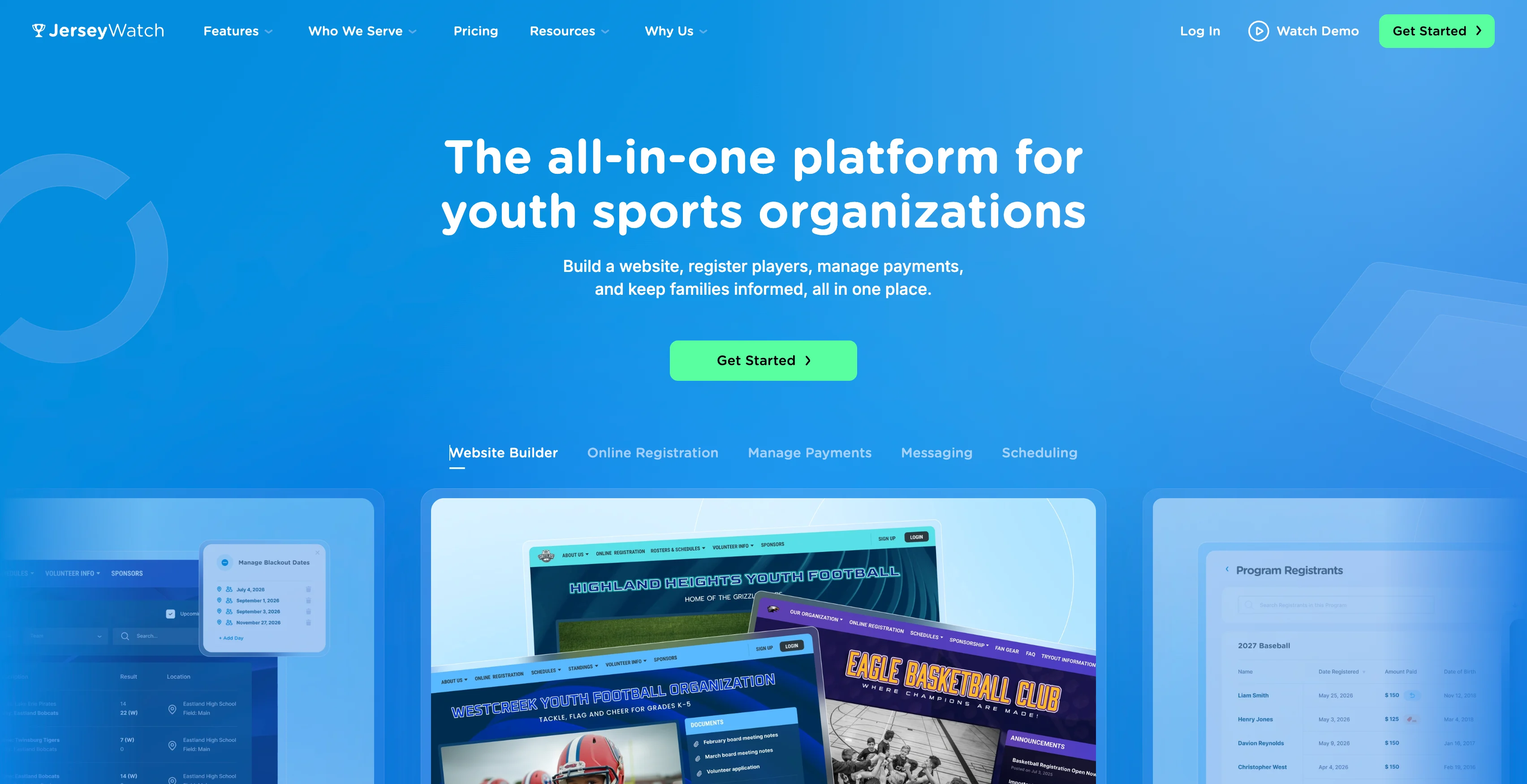
Jersey Watch fits volunteer-run youth basketball leagues that want registration, payments, a website, messaging, and scheduling working together in one system, instead of managed across separate apps. No one on your board needs coding experience to make it work.
You can open basketball registration, collect payments, and publish gym schedules to a custom website and send notifications to parents. The Customer Care team helps design your website, set up a custom domain and if you have an existing site, moves your previous content over.
Create an account and walk through the setup yourself before committing to anything. Pricing starts with a $19 first month to get your site live and registration open, then $348 for the year after that, plus 3.5% + $1 per transaction. Five-star customer support is available whenever you need help.
TeamSnap ONE
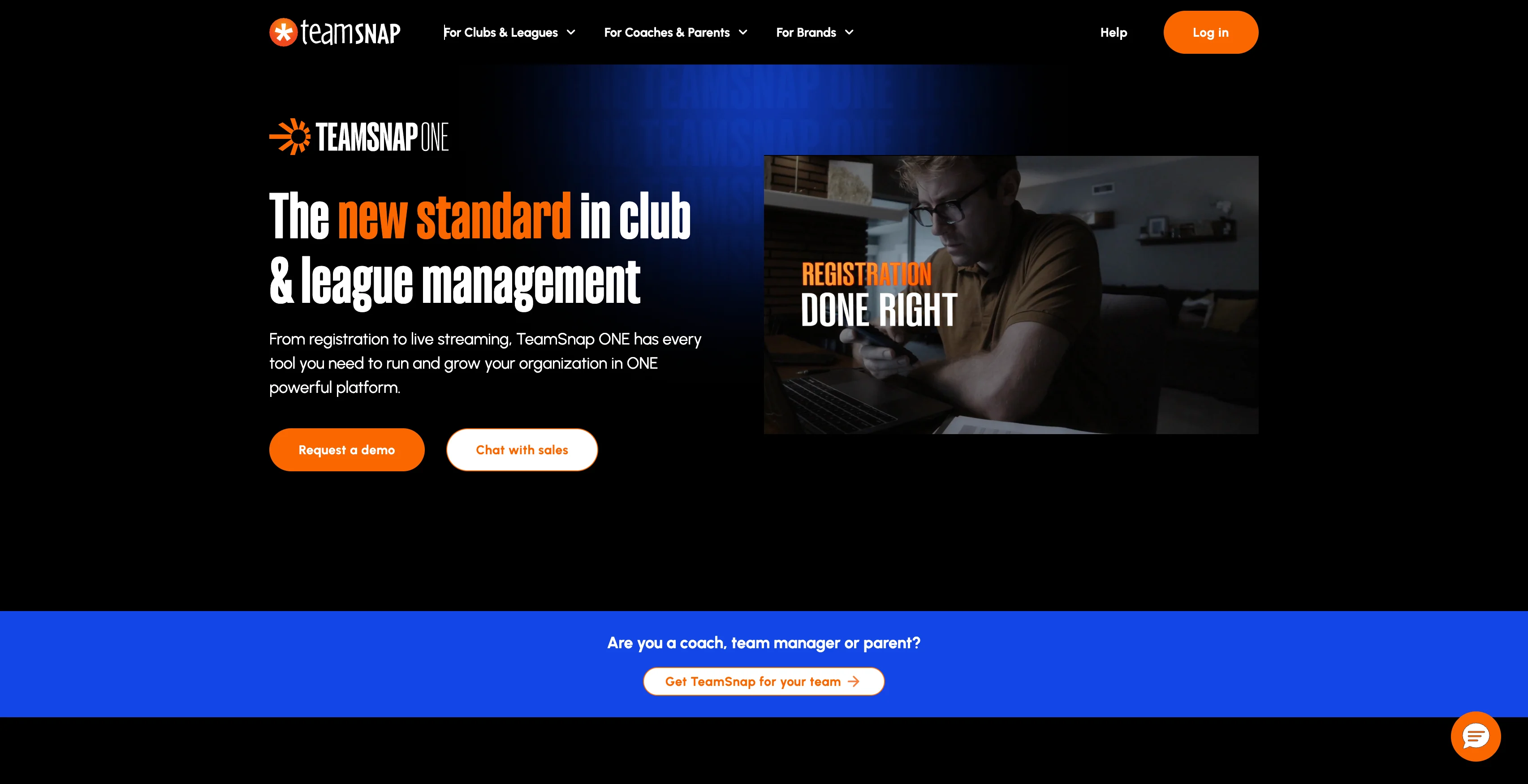
TeamSnap ONE fits basketball organizations whose main buying decision is league-level registration and administration rather than team chat. It's built for boards handling registration across an entire league rather than one roster's practice schedule.
The standalone TeamSnap app that coaches and parents use for lineup reminders and game-day texts is a separate product from TeamSnap ONE, which handles the administrative side: registration, payments, and organization-wide setup.
LeagueApps

LeagueApps may fit larger basketball clubs and travel programs juggling multiple age groups, tournament circuits, and heavy payment volume. When your registration setup gets complicated, like split payments across tryouts, tournament fees, and club dues, and you're processing hundreds of transactions a month, a platform built for that scale can make sense.
LeagueApps handles exactly that kind of complexity. It uses a quote-based, transaction-fee model, so pricing depends on your specific volume and setup rather than a flat published rate.
PlayMetrics
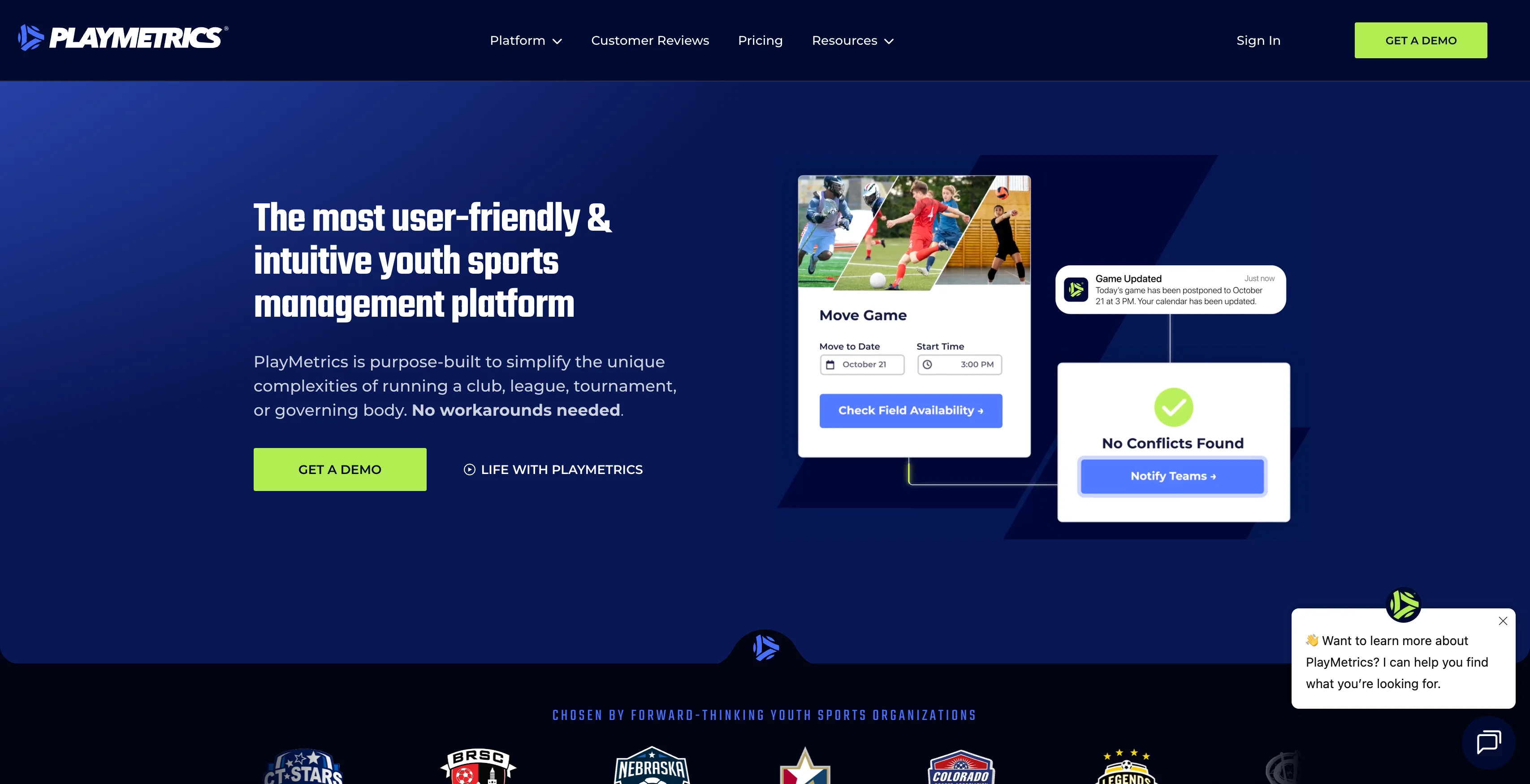
PlayMetrics may be a good fit for large basketball organizations that have already consolidated onto its platform or need a broader, multi-brand sports ecosystem rather than a single-purpose league tool.
PlayMetrics merged with Stack Sports in June 2025 and completed its acquisition of SportsEngine in May 2026, so it's worth confirming PlayMetrics's current product scope directly with a sales rep rather than relying on an older feature list. If your league is weighing a switch, Jersey Watch's guide to PlayMetrics alternatives can help you see how options compare.
Best team communication apps for coaches and parents
A team communication app is the right fit for a single roster, but leagues typically outgrow it once registration, payments, team assignments, and public schedule publishing are added to the workflow. A coach with 12 kids on a travel team just needs attendance tracking, practice reminders, and a fast way to flag a rained-out game. That's a narrow job, and a dedicated app handles it well.
A league administrator faces a different workload. They're assigning hundreds of registrants to teams, collecting fees, publishing gym schedules to the public, and messaging six divisions at once. No single-team app covers that.
Jersey Watch's sports team communication app handles both layers together. If you want a deeper look at standalone apps first, check out Jersey Watch's breakdown of communication apps for sports teams.
What these platforms cost
Basketball software costs go beyond the monthly or annual fee. Setup help, payment processing, and volunteer time all factor into the total. Before comparing numbers, ask what your board will pay upfront, what families will pay per transaction, and how many hours a volunteer will spend getting things running.
Jersey Watch is the only platform here with pricing you can see without booking a call. TeamSnap ONE, LeagueApps, and PlayMetrics all require a quote or demo before you know what you'll pay.
LeagueApps charges transaction fees rather than a flat subscription fee, so your cost scales with registration volume. Jersey Watch bills annually, starting with a $19 first month to launch your site and open registration, then $348 for the year after that, plus 3.5% + $1 per transaction for payment processing. Confirm current numbers on the pricing page before you commit either way.
How to match software to your league's size and volunteer bandwidth
Pick software based on how many players your league serves, how many volunteers show up to help, and how many jobs those volunteers cover each season:
- A 50-player recreational league usually runs on a handful of parent volunteers splitting registration, gym scheduling, and text updates. That group needs one simple tool that handles registration, payments, and messaging without a steep learning curve.
- A 400-player town program has multiple divisions, a treasurer team, and a real need for a public website and organized scheduling across shared gyms. That workload calls for a platform built for league-wide administration rather than a single team's group chat.
- A 2,000-player multi-division organization often has paid or near-paid staff, tournament logistics, and heavier payment volume, which usually justifies a more complex system with dedicated support.
List every job your volunteers handle this season: registration, payments, scheduling, waivers, and messaging. Choose software that fits that list instead of the league you hope to become.
Your league deserves software that works like a teammate
Texting 15 families individually before an 8 a.m. tournament game because the gym schedule shifted is a sign your current system is straining. The same goes for chasing down the family who still owes registration fees three weeks into the season. They're gaps in the tools they're using.
Before you compare another feature list, sit down and map out where your volunteers lose time each week. If it's payment follow-up or last-minute gym changes, that's your starting point.
Jersey Watch was built for that: registration, payments, scheduling, and parent texts living in one place your volunteers can keep up with, backed by a support team that answers when something breaks mid-season. If chasing payments between practices and explaining gym changes over group texts sounds familiar, it's worth seeing how much lighter your week could feel.
FAQs
Can basketball management software help with tryouts and team placement?
Yes. Basketball management software can collect tryout registrations, age groups, waivers, payments, and parent contact details before players arrive. After evaluations, administrators can export rosters or group players by division so coaches can share team assignments faster. For a simple recreational league, this workflow may save more time than a full player analytics tool.
What is the best way to move from paper forms to online basketball registration?
Start with one clear online registration page that covers every basketball age group and program. Add required fields for emergency contacts, jersey sizes, waivers, and payment, then share the link through email, text, and social media. Keep one backup paper option during the first season if families need it, but make the online form the main registration path.
What should a basketball league ask during a software demo?
Ask how long setup takes and who will help build the registration forms and website. The demo should also show how refunds, payment reports, team assignments, gym schedule changes, and parent messages work during a busy weeknight. Focus on real tasks your volunteers perform rather than sitting through a general feature tour.
Should a youth basketball league use the same software as NBA teams?
Generally not. NBA teams use advanced video, analytics, scouting, and performance tools designed for full-time staff. A youth basketball league needs registration, payments, a website, messaging, and schedules before any deeper analysis tools, so a simpler platform is usually easier for volunteers to manage.
Can basketball management software help with shared gym and court schedules?
Yes. A scheduling tool inside basketball management software can organize practices and games across school gyms, community centers, and shared courts. Look for a system that lets administrators update schedules quickly and notify families when school events, weather, or gym conflicts change the plan. Keeping registration contacts, schedules, and messages together makes those updates easier to manage.

Courtney CalvoCustomer Care Team Lead
Courtney Calvo is the Customer Care Team Lead at Jersey Watch, where she helps youth sports organizations get started with registration, websites, and league management tools. She brings both professional expertise supporting leagues and firsthand experience as the parent of a youth soccer player.


