
You're juggling three age divisions on two diamonds, chasing down registration fees through a group text, and trying to remember which parent still owes for uniforms. Somewhere in there, you're also supposed to figure out which software will fix this mess instead of adding another login to manage.
The best baseball league management software helps administrators manage player registration, payments, websites, shared-diamond scheduling, rosters, and family communication in a single, coordinated system. The right option fits your league's size, your baseball-specific rules, your tournament load, and how much time your volunteers have to spare.
You don't need a list of every feature under the sun. You need a clear-eyed way to match what your league runs on to what each platform delivers, so you can pick with confidence and get back to the season ahead.

Why baseball leagues need sport-specific software
Baseball has a few workflows that are different from other youth sports, particularly when it comes to managing age divisions, coordinating games across shared fields, and handling player eligibility.
For most volunteer-run leagues, the priority is finding software that makes the day-to-day work easier without adding unnecessary complexity. If your league shares fields across multiple divisions or has specific age-cutoff rules, look for tools that can handle those workflows without requiring manual workarounds.
When comparing options, consider whether the software can handle your league’s baseball-specific requirements, then weigh those capabilities against how easy the platform is for volunteers and families to use.
Still forming your league? Start with the youth baseball league startup guide, or check out general league management software.
League administration vs. facility management software
League administration software manages players and season operations, like registration, rosters, payments, schedules, and communication. Facility management software manages the booking, availability, and upkeep of physical fields, like field bookings, lighting, maintenance logs, and multi-facility availability.
Owning or operating a complex changes what you need. A league that simply assigns teams to diamonds it doesn't control only needs scheduling that respects existing availability. A league running its own facility also needs to track bookings from outside groups, maintenance schedules, and light usage across multiple fields, which is a heavier operational lift.
Key features baseball leagues need most
Baseball leagues should prioritize registration and payment, a volunteer-friendly website, scheduling, direct communication with families, and a clear process for age eligibility.
Registration built for rec leagues, tryouts, and travel
Rec divisions, travel tiers, tryout sign-ups, uniform add-ons, and payment options should all run through baseball registration software, without requiring volunteers to build separate manual processes for each program.
Custom questions, age divisions, and payment plans reduce the follow-up emails and spreadsheet patchwork that eat up your evenings. A well-built registration system lets you automatically assign the right division, add a uniform-size question, and offer a payment plan for families who need it.
Before you commit to a platform, create a registration form, add a uniform size question, set fees or a payment plan, then complete a test registration. If it captures everything correctly, you've found a system worth trusting.
A website built for a volunteer, not an IT department
A baseball league website should allow volunteers to publish registration links, schedules, standings, and urgent updates without requiring coding or specialized technical support. Volunteers don't need plugins, design skills, or calls to the tech volunteer who set up the site three seasons ago.
Test the parent side first. A parent stuck in the car during a downpour should be able to pull up the site on their phone and see the updated game time in seconds, instead of texting three different board members hoping someone answers.
Then test the admin side. Hand a brand-new board member the login and ask them to change a game time and post an announcement without a manual or a training call. If they can't do it in five minutes, keep looking. Browsing baseball website templates built for this exact job is a good place to start.
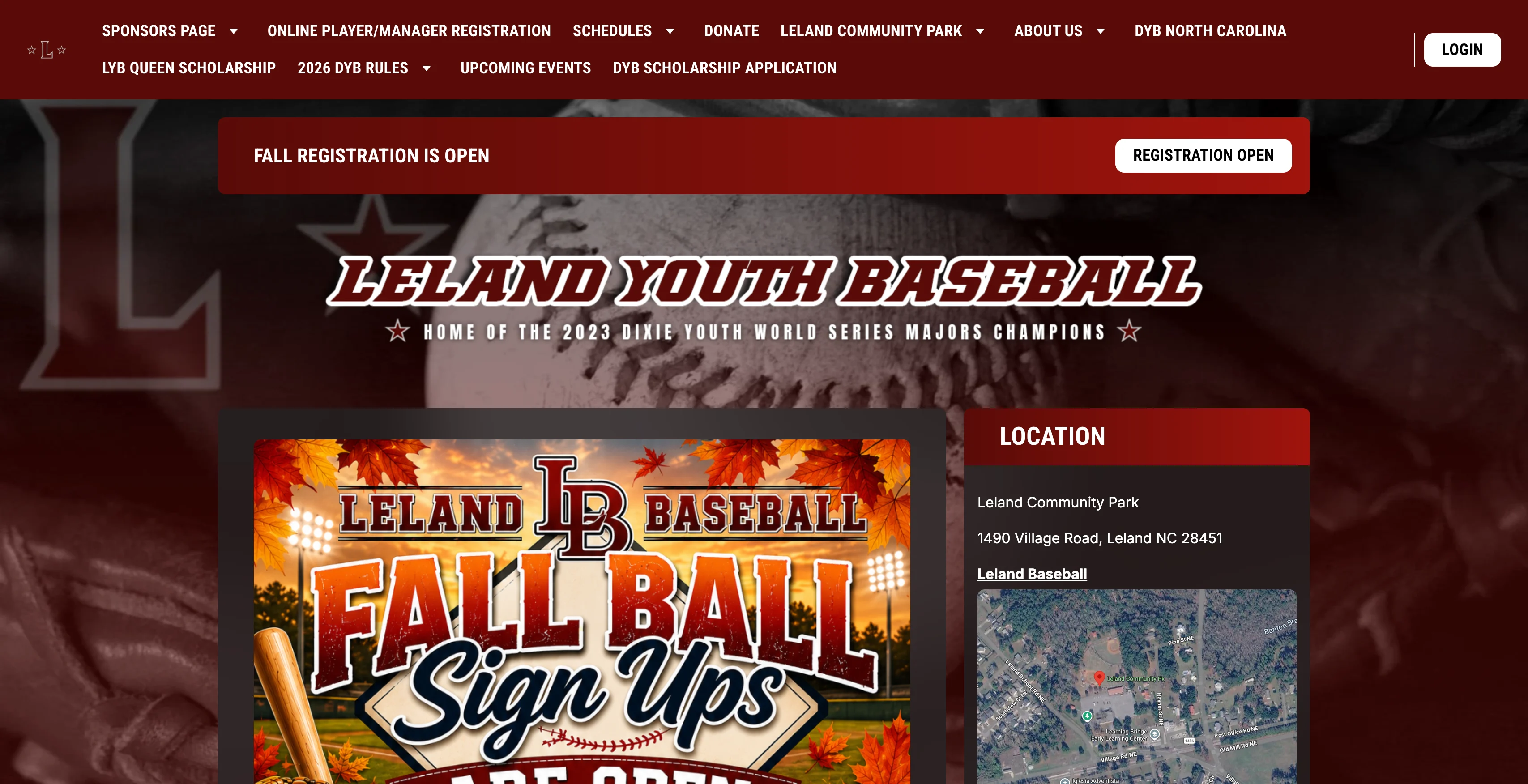
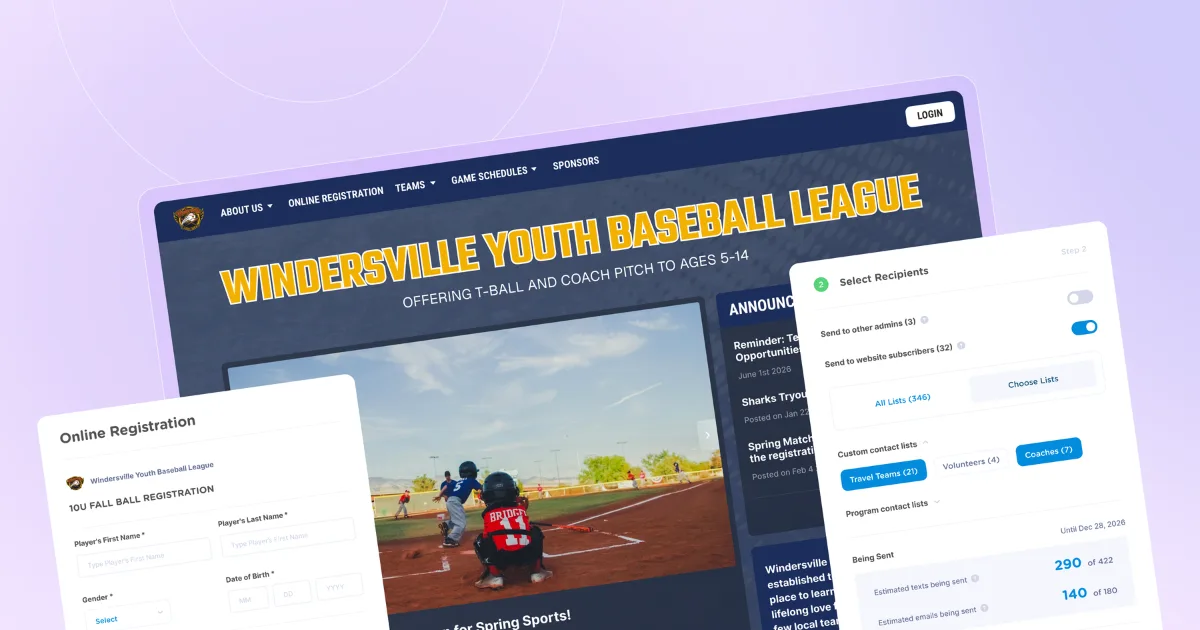
A youth baseball organization website built using Jersey Watch
Diamond scheduling for shared fields, doubleheaders, and tournament weekends
Diamond scheduling software should coordinate limited fields across multiple divisions, game lengths, practices, and tournament days without relying on a single manual spreadsheet. Your league likely shares two or three diamonds across several age groups, and each division may play a different game length.
Look for scheduling tools that can take your league’s divisions, teams, fields, and available dates into account when building a season schedule. A schedule generator can save volunteer administrators hours of manual work, especially when multiple teams or divisions share the same fields. Just as important, make sure you can adjust the schedule after it’s generated. Rescheduled games, field changes, and one-off events are common during a season, so volunteers should be able to make individual updates without rebuilding the entire schedule.
Communication tools for parents, coaches, and volunteers
Built-in text and email tools help you send urgent field changes to the right parents, coaches, or volunteers more reliably than social media alone. You've got a rainout call to make 20 minutes before first pitch, and families are already loading up the car. A text lands on their phone immediately, while a Facebook post might sit unseen until they're already at the field.
Save email for season-long details like schedules, fundraisers, or registration reminders that don't need instant action.
Before choosing a platform, log in from your phone and test the messaging tools directly. Most platforms will allow you to send yourself and admin test messages, import contacts and view a Contact Manager. Make sure to verify that you have flexibility to determine which groups get messages and when.
Age-eligibility verification
Age-eligibility verification means checking every player's birth date against Little League's official league-age chart before assigning that player to a division or roster. Some platforms build this check in or connect directly to Little League's system. Others leave it entirely up to your volunteers, which means someone has to build a manual review process from scratch.
Look to see how each platform handles birth date collection, supporting documents such as birth certificates, official cutoff dates, exceptions for special circumstances, and auditing of records in the event a division is challenged later.
Once eligibility is confirmed, that verified age bracket becomes the foundation for tryouts and roster building. If you're setting up tryouts this season, explore our guide on how to run a baseball tryout.
With Jersey Watch's registration feature, admin can set age eligibility requirements
What baseball league software typically costs
The total cost of baseball league software depends on the platform's subscription, setup, payment-processing, and add-on charges, and is typically billed annually. Some vendors bundle everything into one price, while others charge separately for setup, extra modules, or processing fees, so the number on the homepage isn't always the number on your invoice.
Ask each vendor to break down four things: the base subscription, one-time setup fees, how payment processing is charged, and the cost of add-ons like extra communication tools or scheduling modules.
6 baseball platforms worth comparing
Jersey Watch, LeagueApps, SportsPlus, SportsEngine HQ, PlayMetrics, and TeamSideline are worth evaluating against a baseball league's size, scheduling needs, eligibility process, and volunteer capacity.
Each profile below focuses on three things: which type of league it fits best, which baseball workflows it handles, and what you can expect to pay.
Platform | Best for | Registration & payments | Website | Diamond scheduling | Communication | Pricing |
Jersey Watch | Volunteer-run clubs and leagues | Custom forms and flexible payment options | Drag-and-drop builder with custom domain | Event and games scheduling with calendar syncing | Send immediately or schedule emails and SMS | $19 first month, then $348/year, billed annually |
LeagueApps | High-volume multi-program orgs | Custom forms, invoicing and flexible payments | Optional add-on, backed by WordPress | Automated scheduling and tournament brackets | Email and in-app chat messaging | Setup fee plus transaction fee, not published |
SportsPlus | Multi-team, multi-facility programs | Custom forms, waitlists and payments | Templates, includes custom domain | Auto-generated, tournaments and import | Email, SMS and mobile app | Starts at $396 a year for 100 members. |
SportsEngine HQ | Larger, multi-program associations | Custom forms, flexible payments | Dozens of templates with drag-and-drop editing | Create events, show stats and auto-schedule | Messaging to individuals and groups, mobile app | Not published, custom pricing |
PlayMetrics | Little League-affiliated leagues (2027+) | Flexible forms, waitlists and invoicing | Data-synced website, marketing site not included | Game schedules, automated change alerts | Club-wide messaging and mobile app | Not published, custom pricing |
TeamSideline | Large municipal or Little League-affiliated leagues | Little League Data Center Roster Import | Ready-to-use templates | Multi-organization scheduling | Text and email alerts and automated reminders | Starts at $599 per year |
Jersey Watch
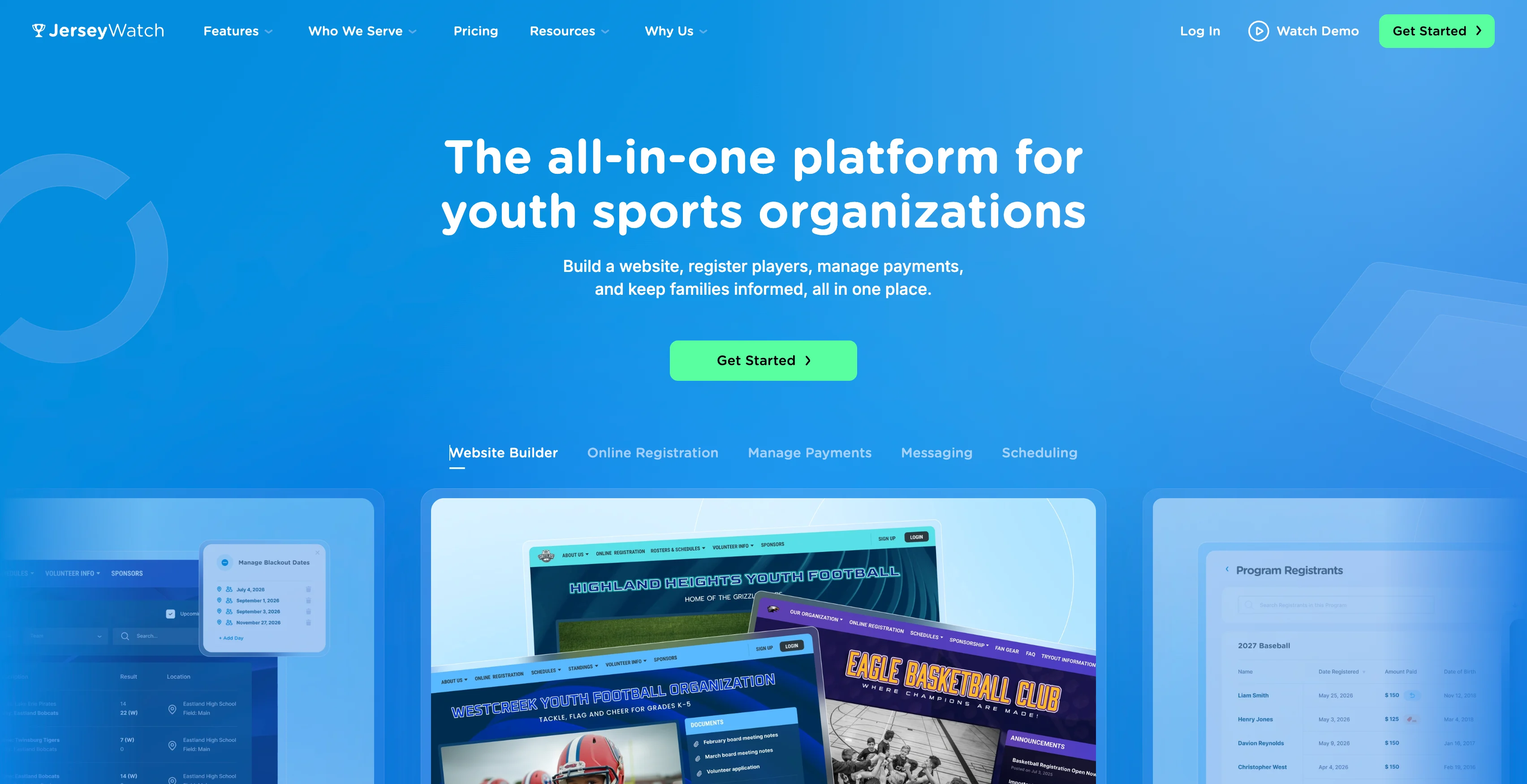
Best for: Volunteer-run baseball leagues that want registration and payments paired with a website builder, scheduling, and direct communication without needing an IT department.
Jersey Watch covers registration and payments, website building, automatic schedule generation based on field availability and game length, automatic standings tracking, text and email communication, and background checks, all in one login.
Standout features: Online registration and payment collection, code-free website builder with free domain and design support and five-star customer support which includes free content migration.
Volunteer ease: High. Jersey Watch is built for volunteer-run community organizations so the product and support are tailored to non-technical users. See what users say about Jersey Watch.
Pricing: Pricing is $19 for month one, then $348 billed annually, plus 3.5% + $1 per transaction.
LeagueApps

Best for: Larger or multi-program organizations that have high payment and registration volume.
LeagueApps covers registration, payment processing, website hosting, scheduling, roster management, communication, mobile tools, and facility scheduling, as well as administrative controls for managing staff and permissions across programs. They work well with organizations who process a high volume of payments so smaller, volunteer-run organizations may find that the depth may be more than what’s needed day-to-day.
Standout features: High-volume registration, multi-program administration, facility scheduling, robust reporting.
Volunteer ease: Moderate to heavy. Better suited to organizations with dedicated administrative staff.
Pricing: Pricing is transaction-based. LeagueApps charges a percentage of each online payment rather than a flat subscription, plus a one-time setup fee.
SportsPlus
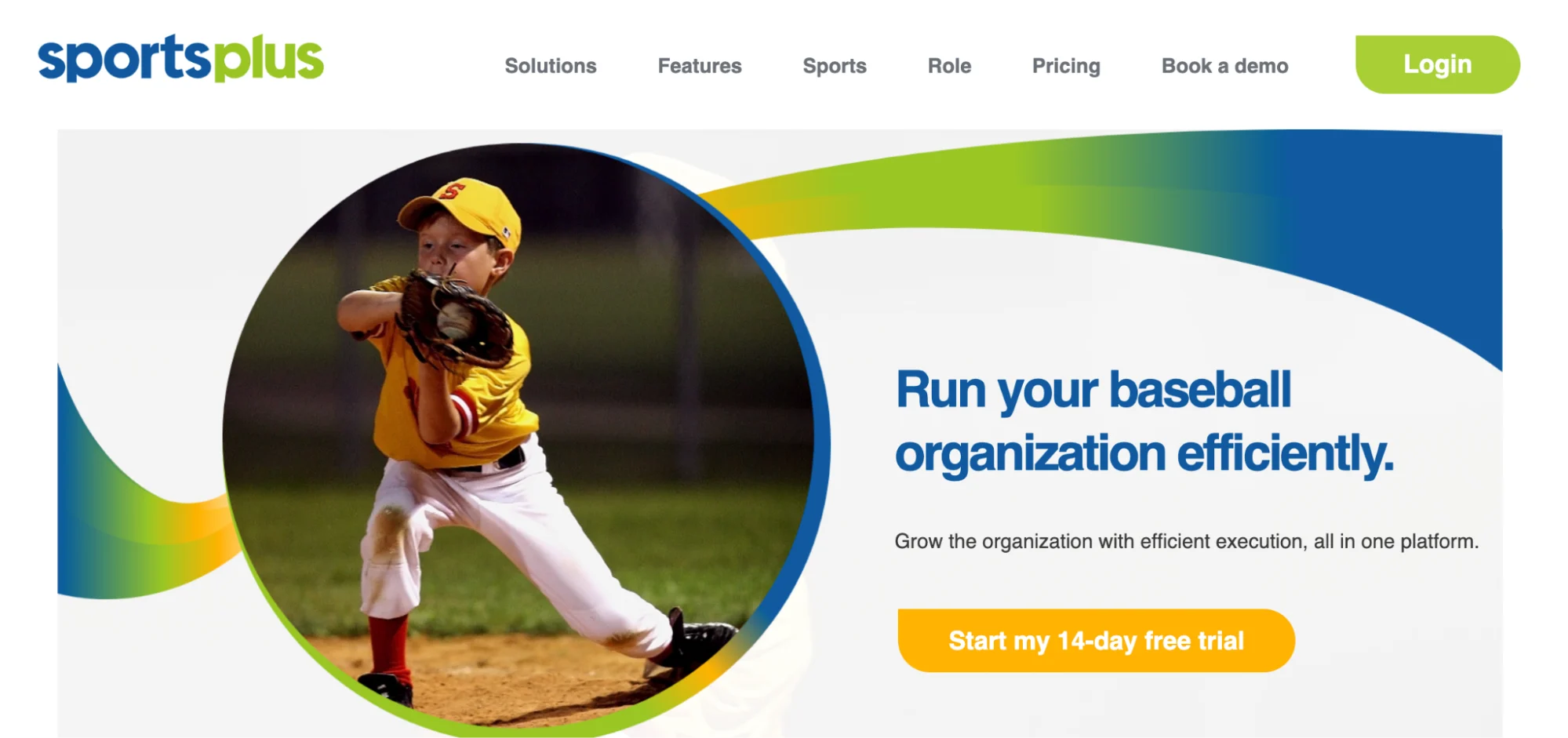
Best for: Baseball organizations managing multiple teams, programs, or facilities that want broad administrative and scheduling capabilities in one place.
SportsPlus bundles registration and payments, schedule generation or import, roster and volunteer management, fundraising tools, and a team app for game-day updates. That combination allows them to serve organizations ranging from clubs and sports governing bodies to parks and recreation.
Standout features: Automated scheduling, multi-facility coordination, mobile app for coaches and parents, fundraising tools.
Volunteer ease: Moderate. Setup and configuration may require more initial time than simpler platforms.
Pricing: Pricing starts at $33 per month, billed annually. Plans are based on the number of members and teams an organization has.
SportsEngine HQ
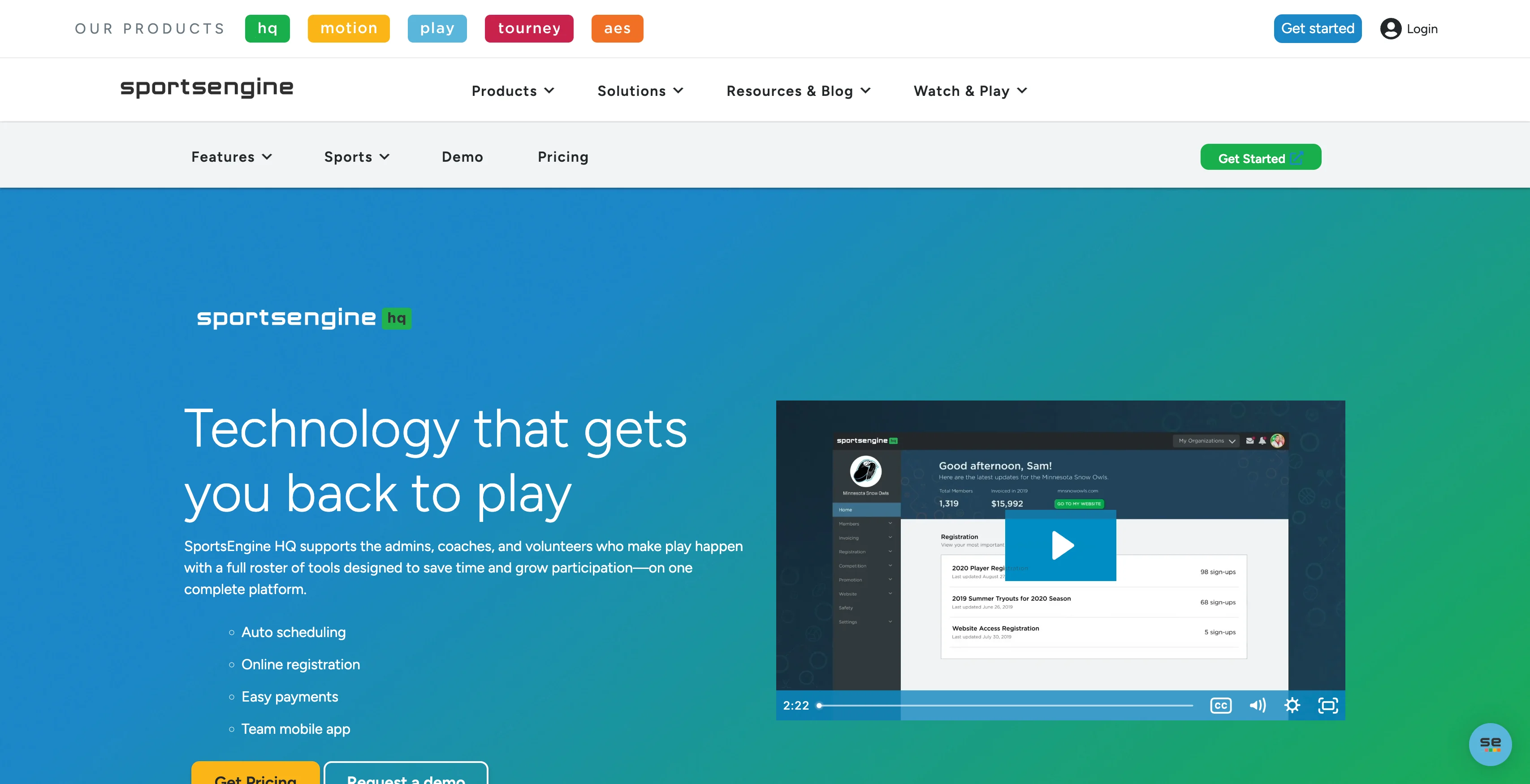
Best for: Larger baseball organizations that want an established platform with broad website and administrative tools.
SportsEngine HQ includes registration, website hosting, financial management, team management, scheduling, stats and scores, apparel integrations, and mobile tools for coaches on the go. That range tends to suit bigger leagues juggling multiple programs rather than a single volunteer-run division.
Standout features: Registration, public website, financial management, stats and scoring, mobile app.
Volunteer ease: Moderate to low. Feature depth may require more administrative time for smaller boards and a larger learning curve for non-technical users.
Pricing: Pricing is customized based on organization structure, size and goals.
PlayMetrics
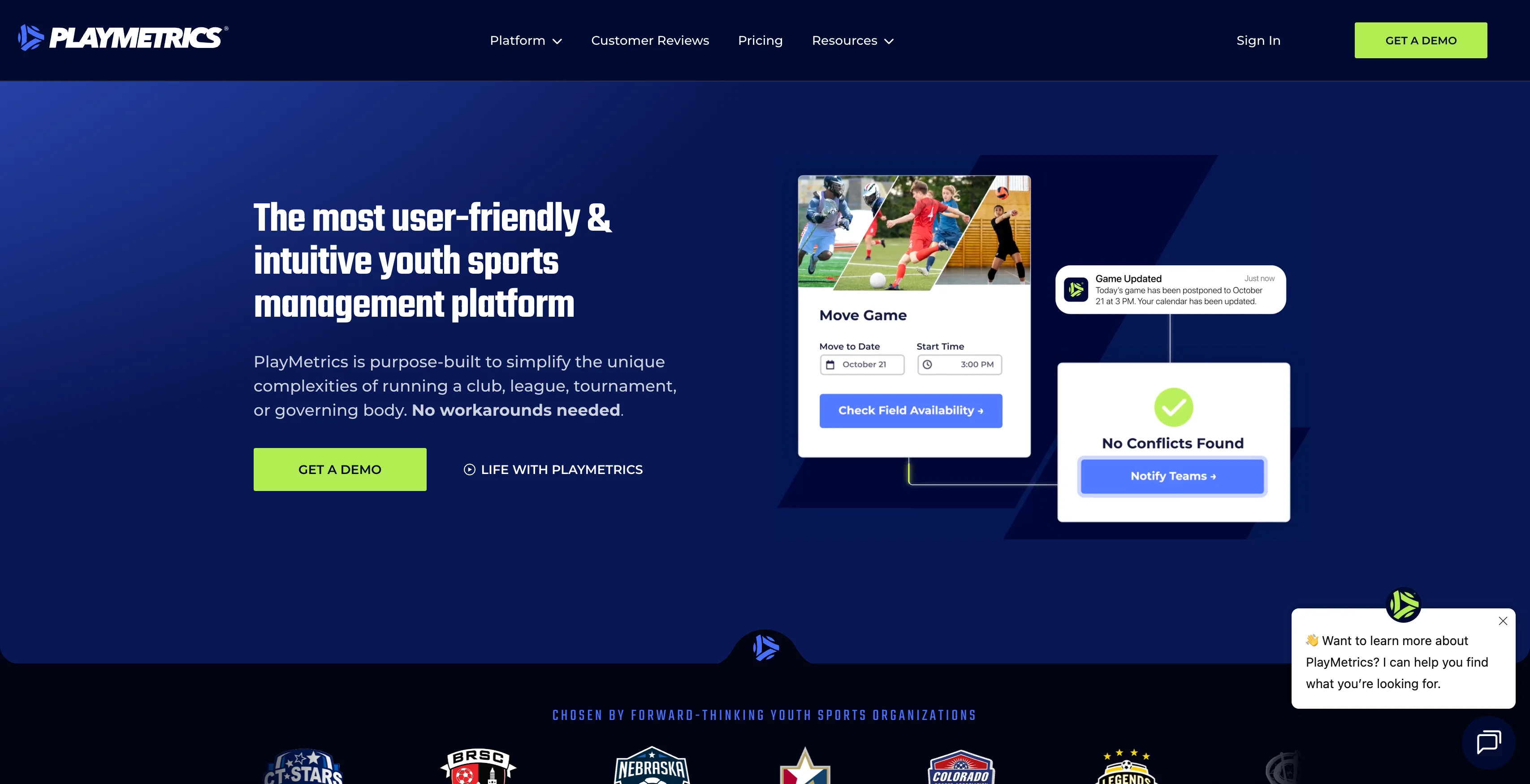
Best for: Little League-affiliated organizations, particularly those planning for the 2027 season transition.
PlayMetrics has served as Little League's official league technology provider since 2016. Beginning with the 2027 season, leagues will manage player registration, league operations, and volunteer management directly in PlayMetrics. That transition is expected to bring eligibility checks connected to the Little League Data Center into the platform, which could eliminate the manual birth-date cross-checking your board currently handles each spring.
Standout features: Little League integration, registration, payments, and eligibility tooling for affiliated leagues.
Volunteer ease: Varies. Confirm the current migration timeline, eligibility functionality, and support structure directly with PlayMetrics before signing on.
Pricing: Pricing is quote-based.
TeamSideline

Best for: Little League-affiliated organizations, municipal leagues and parks and recreation departments that want advanced administrative features and customization options that suit large organizations with complex operational needs.
TeamSideline offers Little League Data Center roster imports so volunteers aren't re-entering rosters by hand each season, along with birth certificate and age verification. They include features tailored to larger organizations such as facility, membership and officials management.
Standout features: Little League Data Center roster import, membership management, officials management and roster building.
Volunteer ease: Moderate. TeamSideline users range from clubs and leagues to parks and recreation departments with paid staff. Users report a higher level of complexity but timely and helpful support.
Pricing: Pricing starts at $599 per year with the option to pay for additional add-ons like advanced scheduling and background checks.
Choose baseball software that fits the season
The right baseball league management software isn't always the one with the longest feature list. Several platforms in this comparison offer robust tools, but come with a learning curve that's hard to justify when your registrar is a parent volunteer with two hours a week to spare. The better question is what your board can keep up with once the season gets busy.
That's where Jersey Watch fits. It covers the features a volunteer-run baseball league needs most: registration and payments, a website your board can update without a training call, scheduling, and communication tools that reach families before the questions start. The setup is straightforward, the support is responsive, and nothing requires a technical background to run.
No system erases the work of running a league. But the right one shrinks the part that eats your evenings, so you can spend more of them at the field.
Ready to see what that looks like for your season? Get started with Jersey Watch today.
FAQs
What is the best baseball league management software for a youth league?
A league's size, tournament schedule, budget, and available volunteer time determine the best fit. Jersey Watch works well for volunteer-run rec and travel leagues that want registration, a website, scheduling, and communication tools designed to be easy to manage. Larger clubs with more complex administrative or facility needs may prefer platforms such as SportsEngine HQ or LeagueApps.
What features should baseball league management software include?
Registration and payments, a baseball-ready website, diamond scheduling, roster tools, and direct text and email communication are the core features to look for. Registration should support tryouts, rec and travel tiers, payment options, and add-ons such as uniforms. Scheduling should account for shared fields, divisions, game lengths, doubleheaders, and tournament weekends, while the eligibility process should help administrators apply the correct age cutoffs without manual cross-checking.
How is baseball league management software different from general sports league software?
Baseball-focused software accounts for workflows such as coordinating shared diamonds, scheduling doubleheaders, organizing multi-day tournaments, and applying age-based division rules. General sports software may handle registration and basic schedules, but it treats every sport similarly. Baseball leagues should confirm that a platform can support their field constraints and eligibility process without extra spreadsheets or manual workarounds.
Does baseball league management software help verify player eligibility?
Many platforms provide roster tools that help administrators check age-bracket eligibility against league-specific cutoff dates. Some connect directly with Little League systems or support birth certificate and age verification, while others require volunteers to manage the review process themselves. Administrators should confirm how each platform handles birth dates, supporting documents, exceptions, and eligibility records before choosing.
What should volunteer-run baseball leagues look for when comparing software platforms?
Easy setup, registration, and payments; a manageable website; shared-diamond scheduling; direct communication; and clear annual pricing are the priorities. Ask a registrar, scheduler, and treasurer to test the workflows they'll actually use, including mobile registration, schedule generation, and targeted weather alerts. Compare setup fees, payment processing costs, add-ons, and the advertised subscription price before deciding.

Tim GusweilerCo-Founder / CEO
Tim is the Co-Founder of Jersey Watch, where he works with the product, marketing, and customer support teams to build software for youth sports organizations. He writes about youth sports management based on years of experience working with league administrators, coaches, and volunteers, along with a lifelong passion for sports.


